Amiri Clothing Deals Bone Applique Detail
Frequently Asked Questions About AMIRI
Most of these questions come from people searching amiri, amiri men, amiri clothing or buy amiri online, and many exist because the same errors keep circulating. The answers stay with what the house publishes, what court records and trade press show, and what the product pages say. Where sources genuinely disagree, that is said plainly rather than settled by picking a side. Prices are observed market listings gathered in 2026, not an official price list. Nothing below is a valuation, a forecast or investment advice. The house styles itself in capitals, and it is a Los Angeles label that shows in Paris, not a French or Italian one.
Is there such a thing as an official AMIRI outlet?
No, there is not, and it is the one to keep in mind. AMIRI put this in writing in a federal court complaint filed in July 2021, declaring that it „does not have an AMIRI outlet store, nor has it ever authorized any person or business to operate such a store.“ That suit went to the United States District Court for the Central District of California, aimed at an internet service provider accused of hosting a counterfeit site posing as an AMIRI outlet, and it was dismissed that September. No outlet exists anywhere, online or physical, and nobody has ever been authorised to run one. Legitimate discounted stock exists, but it comes from authorised retailers‘ sale sections and from off-price arms amiri clothing of retail groups. If a storefront calls itself an AMIRI outlet, it is not the brand, whatever the site says.
Is all amiri clothing made in Los Angeles?
No, and that blanket claim is one of the most repeated errors about this label. Country of origin varies by style, and the brand states it openly on its own product pages. Manufacture of the MX1 jean, the Stack jean and the MA Core Logo Hoodie happens in the United States, and the MA Bar Logo Tee is made in Los Angeles. The MA Core Logo Tee is made in Italy, while the Skel Top Low and the Skel Court Hi are made in Vietnam. This is what trips buyers up: a Vietnamese origin stamp inside a Skel-Top is correct, not evidence of a counterfeit. It is the reverse that would be suspicious: a jean claiming Italian manufacture, say, or a Skel-Top claiming American assembly.
Which sneaker does the house call its signature?
The Skel-Top Low, without ambiguity, since it is the only model the brand’s own copy calls its house signature sneaker. It is a basketball silhouette in leather and suede on a two-tone rubber sole, with hand-cut bone appliqués in contrast topstitching. Against an original retail of $590 at an August 2020 release, observed pricing now runs to $650, so a listing still quoting $590 is stale. Three models get confused with one another and should not be. A canvas retro-court style observed at $690 is the Skel Court; the Stars Court is the same silhouette but with star appliqués rather than bones. The Bone Runner is real, but its release year is not documented and it now surfaces mainly at off-price and on resale.
Is the MA-1 here a bomber jacket?
Not in this line, though the confusion is understandable. Across the wider market MA-1 is the generic United States military designation for a flight jacket, applied by many brands; here it names a sneaker, observed at $799 in low and high versions. MA stands for the founder’s initials and prefixes several sub-lines rather than referencing military nomenclature. MA Bar, MA Core, MA Quad, MA Fit and MA Skyline are among them, and between them they cover tees, hoodies, denim fits and footwear. MA Bar and MA Core are two different tees, routinely written up as a single thing. No flagship named bomber jacket turned up in the current line, so any article built around one should be read with suspicion.
When did the label start, and under whom?
Mike Amiri, an American designer of Iranian parentage, is the founder and creative director; the founding year, on the other hand, is genuinely contested. On the brand’s own about page, he started the label in his hometown of Los Angeles in 2014, and CFDA and OTB Group line up behind that. A PRNewswire release dated December 2014 carries a different year, putting the founding in 2013, in partnership with the Los Angeles retailer Maxfield. Both can be cited, which makes the safest formulation this: the house dates itself to 2014, while the earliest contemporaneous release says 2013. The debut was an exclusive capsule at Maxfield, confirmed by the brand and the CFDA. In brand and CFDA copy the start is described generically, as hand-crafting stage pieces for legendary Los Angeles performers; where retail editorial names rock clients, the naming is editorial, not confirmed.
What is the real number of AMIRI stores?
The brand’s own retail-locations page gives roughly thirty-three, counting in boutiques still marked as coming soon. Trade reporting puts it near thirty-one standing boutiques in 2026 after the Milan opening, consistent with the official list. One hundred and ninety-five stores is a figure that gets copied everywhere, and it is wrong; never repeat it. It looks like a conflation of wholesale doors with owned stores, because the brand separately works with about one hundred and fifty wholesale accounts across some four hundred points of sale. The first permanent store arrived on Rodeo Drive in Beverly Hills in 2020, and Milan later became the first permanent European location. Anyone quoting a three-figure store count is repeating that error.
What are the true amiri jeans style names?
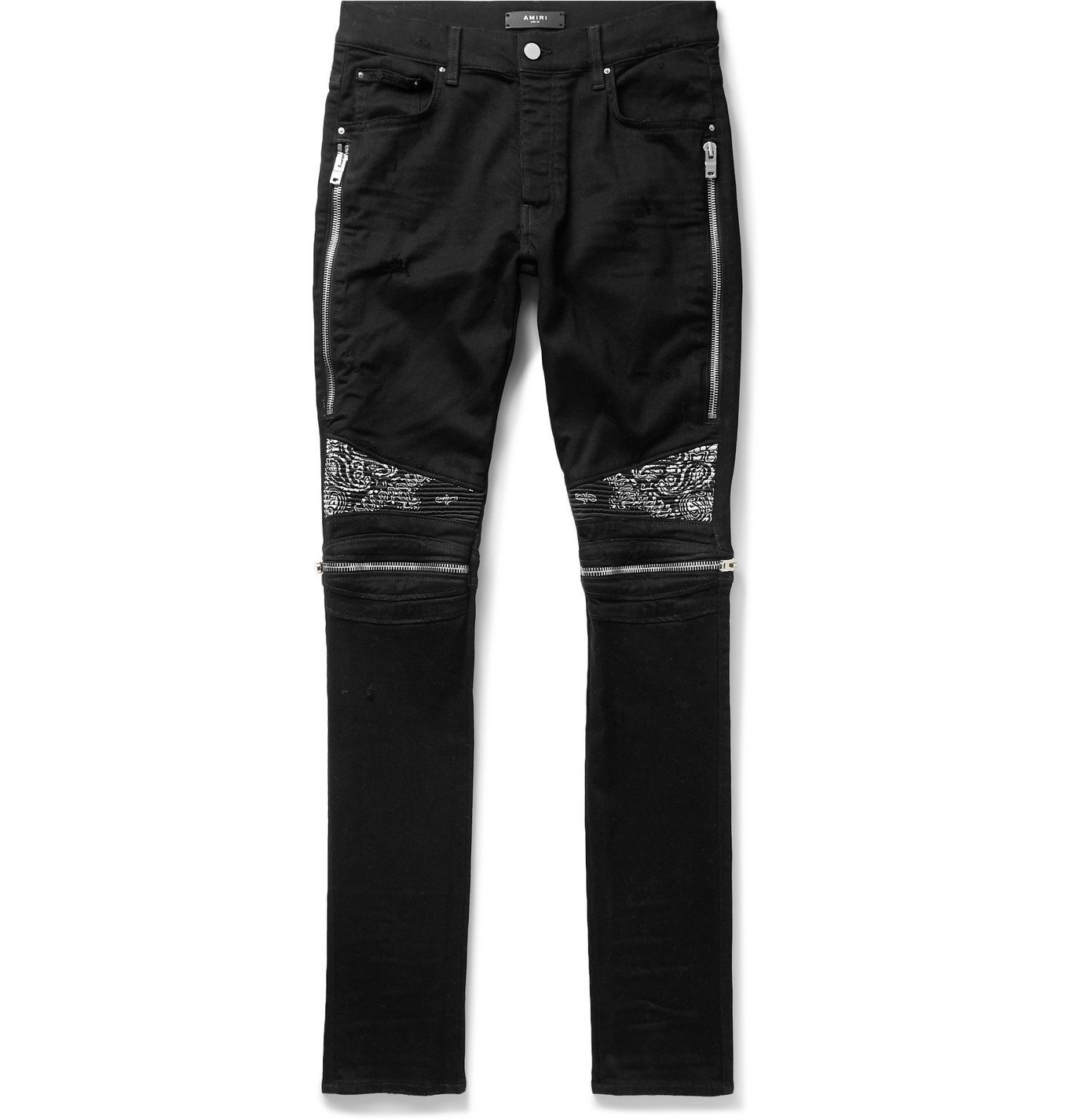
The line splits into two kinds of name, and conflating them is the commonest mistake in writing about this brand. Fit and model names include the MX1, MX2, Thrasher, Stack, Shotgun, Carpenter, MA Fit and Baggy, alongside Repair and Patchwork constructions. Treatments run across those models include Bandana, Crystal, Stud, Eagle, Aloha and Monogram, which makes Bandana and Crystal treatments rather than fits, even though a Bandana Repair Straight Jean exists as a full product name. The MX1 is the signature, repaired with pleated ovine leather; the Thrasher is the pure hand-distressed expression without that structured panel; the Shotgun carries blown-out frayed holes with sanded edges. MX3 exists only as a women’s Baggy MX3, a motocross-inspired hybrid observed at $990, rather than a men’s tier above the MX1. A denim name that appears on a third-party list but not on the brand’s own pages is almost certainly descriptive language, not a model name.
What do the principal pieces cost?
The figures below were taken from live listings in 2026 and are observed market prices, not an official price list. They move, they vary by region and currency, and multi-brand retailers price differently again. Discounting is structural, with observed in-season reductions of forty to seventy percent at authorised retailers and deeper cuts again off-price. The entry point is a T-shirt at around $425 to $460; at the other end, worked outerwear such as a varsity jacket has been found listed above $2,300. Embellished, crystal-set and heavily reconstructed pieces sit above the standard band in every category. A core amiri hoodie and a Skel-Top settle on the same observed figure, which makes a useful anchor.
| Piece | Observed price, 2026 |
|---|---|
| Stack jean | $750 |
| MX1 jean | $1,090 |
| Baggy MX3 for women | $990 |
| MA Core Logo Hoodie | $650 |
| Skel Top Low | $650 |
| Skel Court Hi | $690 |
| MA-1, the sneaker | $799 |
| Ryder Boot | $1,090 to $1,290 |
Where is it safe to buy, and does the brand authenticate resale pieces?
The only official online shop is the brand’s own site; every other legitimate seller should appear on the stockists page the house publishes. Department stores and specialist boutiques across Europe, North America and Asia appear on that page, as does a shorter list of approved online retailers. It is not closely maintained, since it still names a British retailer that closed in 2024, so treat it as a recognition list rather than a live directory. Farfetch sits in the middle, absent from that official online list yet selling through partner boutiques that are stockists, so it is neither an official stockist nor an unauthorised seller. The brand’s position on authentication is explicit: it can only verify products bought directly from it or through an authorised stockist partner, and anything bought elsewhere is outside that. No brand-operated authentication app, tag or code verification was found, so provenance and a retained invoice are the practical protection.
How big is the business, and who owns it?
Majority ownership belongs to Mike Amiri, who also retains creative and operational control. A minority stake in the house was taken in 2019 by OTB Group, the Italian holding chaired by Diesel founder Renzo Rosso, acting as a strategic partner. Neither the deal terms nor the stake percentage is public, which means a quoted percentage anywhere is invented. On scale, the founder said the brand surpassed three hundred million dollars in sales in the prior year, a statement relayed by press rather than an audited figure. The company is privately held, no audited financials are public, and circulating valuation or net-worth numbers have no sourcing behind them. The dependable milestones are easier to rely on: a Paris Fashion Week debut in 2018, womenswear in 2021, and the Amiri Prize, launched in 2021, worth one hundred thousand dollars plus a year of mentorship.